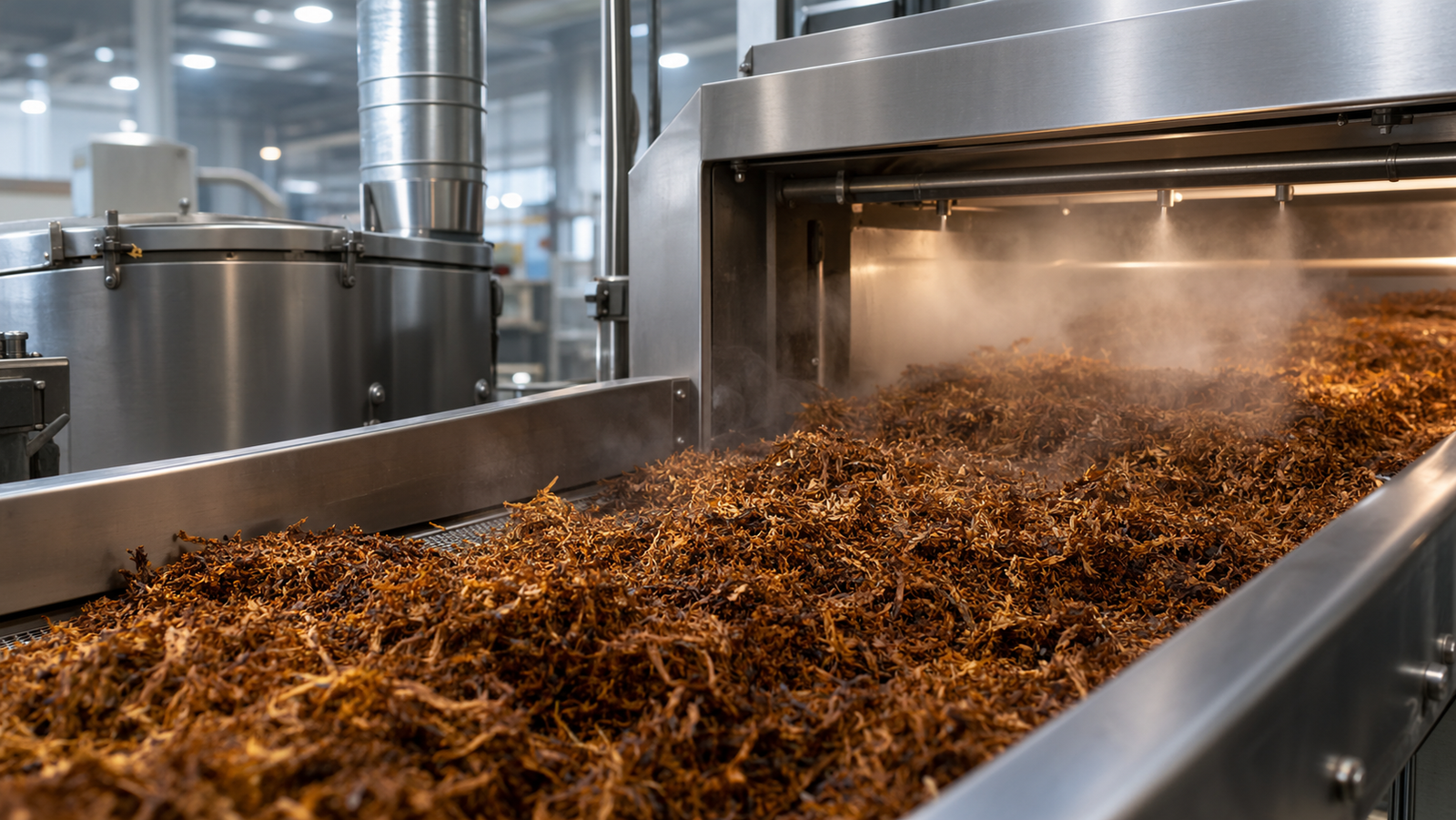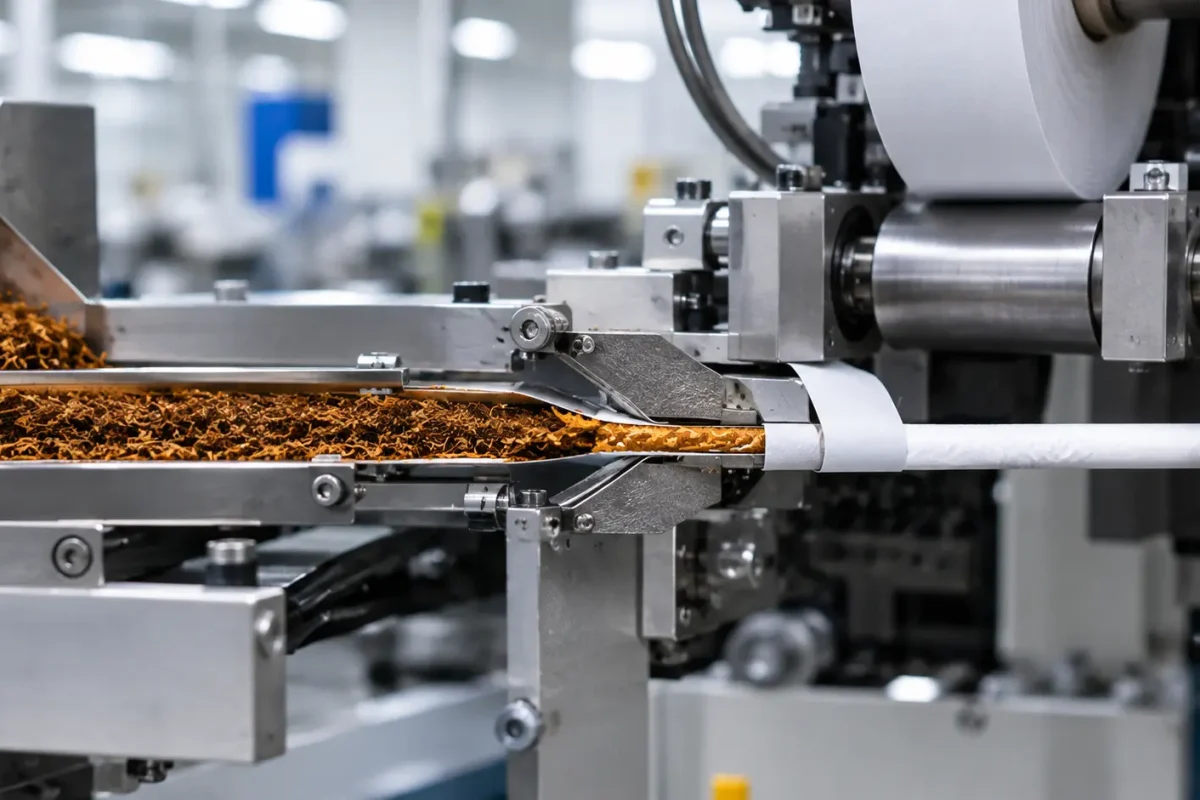
Cigarette rod formation is the manufacturing stage where loose cut tobacco is metered, compressed, and wrapped into a continuous paper-covered cord, then cut into individual cigarette lengths. It’s the step between raw cut tobacco and a finished, uncut cigarette rod, and it’s where a cigarette’s weight, density and draw characteristics are actually determined.
Tobacco Metering and Spreading
Rod formation starts with cut tobacco being fed through counter-rotating rollers fitted with small pins. These rollers meter the tobacco and separate individual particles from one another, so no clumps or uneven pockets carry through to the next stage. The metered tobacco is then formed into a thin, evenly distributed falling stream, sometimes called a tobacco shower or fleece, spread uniformly across the width of the machine. This stage matters more than it might look: whatever unevenness exists in the tobacco stream here carries straight through to the finished rod.
Suction Collection
The falling tobacco stream lands on a moving, air-permeable conveyor tape. Suction beneath the tape holds the individual tobacco particles in place as the tape travels, building up a continuous strand of loose tobacco across its surface. Because the tape is constantly moving and the tobacco shower is continuously falling, this creates an unbroken stream of tobacco rather than a series of separate batches, which is what allows a rod-making machine to run continuously rather than starting and stopping for every cigarette.
Compression and Density Control
The loose tobacco strand then passes through constriction components, referred to in equipment design as a tongue, compression foot, or compacting finger, that press the tobacco into a properly packed cord of consistent diameter. This is the stage that actually determines a finished cigarette’s weight, firmness and draw resistance. A rod compressed too loosely burns unevenly and loses tobacco through the open end; one compressed too tightly restricts airflow and changes how the cigarette draws. Getting this stage consistent, run after run, is what keeps every cigarette in a batch behaving the same way. Some higher-speed manufacturing lines introduce controlled moisture at this stage specifically to maintain rod integrity as production speed increases.
The Garniture: Wrapping the Rod
Once compressed, the tobacco cord is wrapped in cigarette paper by a component called the garniture, an endless belt system that gradually folds a continuously fed web of paper around the moving tobacco rod, shaping it into a tube and sealing the seam along its length. This happens while the rod is still moving, the paper isn’t wrapped around a finished, stationary cord, it’s shaped around it in motion, which is part of what allows rod-making machines to produce at high continuous speed.
Cutting to Length
Once the tobacco rod is fully wrapped and sealed, it exists as one continuous paper-covered cord. A rotary cutting device then cuts this cord at precise, evenly spaced intervals, producing individual cigarette lengths, or in many modern high-speed machines, double-length rods that are cut again after filter attachment. From this point, the formed rod moves on to filter attachment and packing.
Why Rod Formation Consistency Matters for Private Label Brands
For a private label or contract manufacturing order, rod formation consistency is what determines whether the tenth thousand cigarette in a production run smokes the same as the first. It’s not a visible spec the way pack design or blend selection is, but it’s one of the main reasons manufacturing quality control matters: a well-controlled rod-forming stage is what keeps weight, draw and burn characteristics stable across an entire order, not just a sample batch. This is a core part of what we manage during private label production, alongside blend and packaging.
Frequently Asked Questions
What determines a cigarette’s weight?
Primarily the compression stage of rod formation, how tightly the tobacco cord is packed as it’s shaped, along with the density and moisture content of the tobacco stream feeding into it.
Why does rod consistency matter across a large production run?
Inconsistent rod formation leads to variation in draw, burn rate and weight from cigarette to cigarette. Consistent metering, suction and compression across the full run is what keeps quality uniform from the first cigarette to the last.
Is rod formation the same as filter attachment?
No. Rod formation covers tobacco metering, compression and paper wrapping into a cut cigarette length. Filter attachment is a separate downstream stage.
What affects how a cigarette draws?
Draw resistance is shaped largely during compression, how densely the tobacco cord is packed, along with paper porosity and, separately, filter specification.
Can additive elements be incorporated during rod formation?
Some modern rod-forming lines can position additive elements along the rod’s axis during the forming stage, a manufacturing capability built into certain high-speed machine configurations.