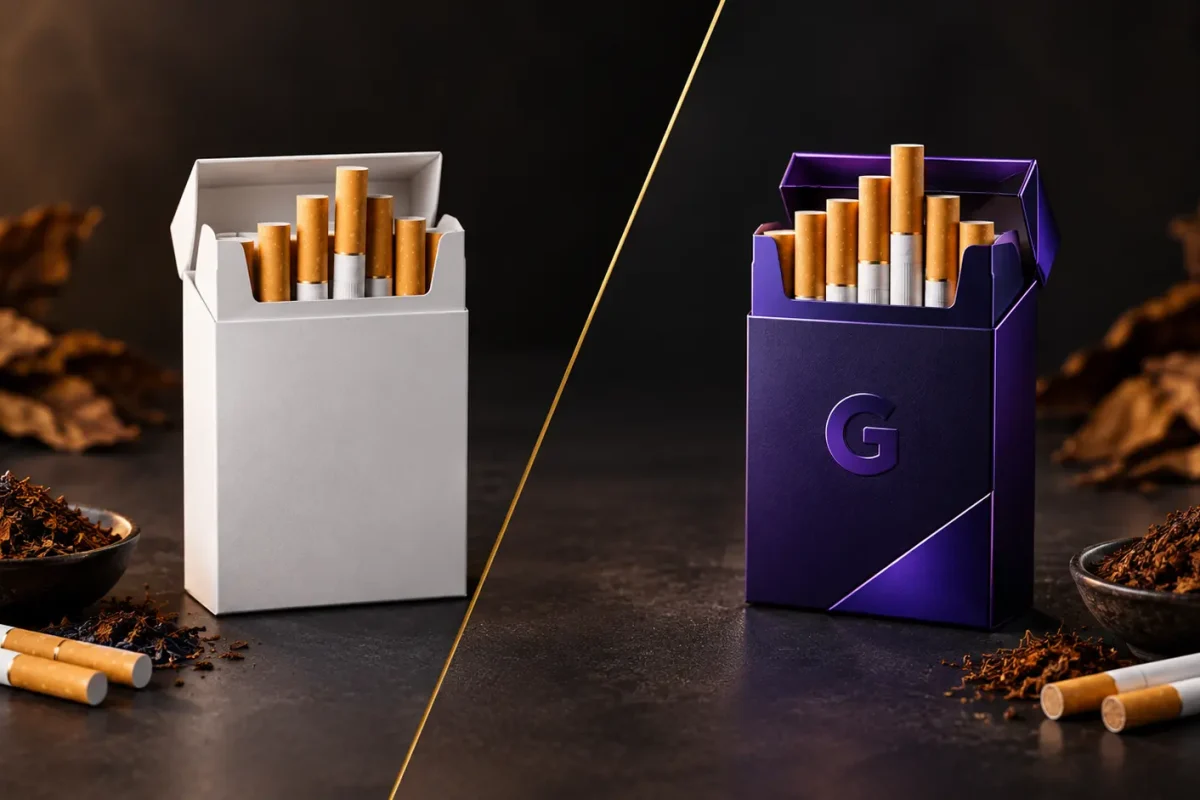
White label cigarettes are built from an existing blend and pack format, with your brand name and packaging applied on top. Private label cigarettes are made to your own specification, blend, format and packaging chosen or developed for your brand specifically. Both let you sell cigarettes under your own name without owning a factory, the difference is how much of the product itself is built around you versus already fixed by the manufacturer.
What Are White Label Cigarettes?
White label cigarettes are produced using a manufacturer’s existing tobacco blend and standard pack format. As the brand owner, you select from what’s already available, blend, filter type, format, and apply your own name, logo and pack design on top. The manufacturer may produce the same underlying blend for other brands as well, only the branding changes from one order to the next. This model is closely related to OEM cigarette manufacturing, and is faster to get to market, since there’s no blend development stage, you’re choosing from options that already exist and are already in production.
What Are Private Label Cigarettes?
Private label cigarettes are manufactured to a specification developed for your brand, blend, format, filter, and packaging shaped around what you want your product to be, rather than picked from a fixed catalog. The manufacturer still handles the actual production, blending, rolling, filtering and packing, but the resulting product is built for your brand rather than adapted from something already running. This model takes more time upfront, since the blend or specification has to be developed and confirmed before production starts, but the result is a product built specifically for your brand rather than shared with others.
Why Cigarette Manufacturing Doesn’t Split as Cleanly
In practice, the sharp line that exists in other industries gets blurry in cigarette manufacturing. Most arrangements described as “private label” still start from a manufacturer’s existing menu of blends and formats, rather than a fully bespoke recipe developed from raw tobacco upward. A brand chooses a blend profile, a cigarette format, and a filter type from what the factory already produces well, then applies its own branding. That’s functionally close to what other industries would call white label, even though it’s commonly marketed as private label in this space. A fully custom, from-scratch blend developed uniquely for one brand is a real option too, but it’s a distinct, higher-investment tier, not what most “private label” cigarette orders actually involve. This is why the two terms are often used loosely, and sometimes interchangeably, in cigarette manufacturing.
The Three Variables That Actually Matter, Not the Label Name
Rather than trying to pin down which word applies, it’s more useful to ask about three things directly:
Blend origin — is the blend selected from an existing range, or developed specifically for your brand?
Exclusivity — is that exact blend and format produced only for you, or can the same specification also go to other brands?
Packaging control — regardless of the blend tier, your branding, pack design and labeling are almost always fully in your control in either model, this is where custom packaging comes in, independent of which blend tier you choose.
These three answers tell you far more about cost, timeline and exclusivity than whether a manufacturer calls the arrangement “white label” or “private label.”
White Label vs Private Label Cigarettes at a Glance
| White Label | Private Label | |
|---|---|---|
| Blend | Existing, chosen from what’s available | Developed or specified for your brand |
| Format | Standard, already in production | Selected or customized to your brand |
| Packaging | Your branding applied | Your branding applied |
| Time to Market | Faster | Longer, blend/spec development required |
| Product Exclusivity | Blend may also be used for other brands | Built around your specification |
Which Model Fits Your Brand
If you want to get to market quickly, with lower upfront investment and no blend development stage, a white label or menu-based private label approach gets a branded product into your hands fastest. If exclusivity and a specification built entirely around your brand matter more than speed, a fully custom private label arrangement is worth the longer timeline. Either way, the manufacturing standard, quality control and packaging control are the same, the difference is in how the blend and format are arrived at.
Frequently Asked Questions
Is white label the same as OEM for cigarettes?
They’re closely related. Both start from an existing product or blend rather than a from-scratch specification, the terms are often used interchangeably in OEM cigarette manufacturing.
Can I start with white label and move to private label later?
Yes. Many brands launch with an existing blend and format to get to market faster, then move to a custom specification once the brand is established.
Does white label mean lower quality?
No. White label cigarettes use the same production lines, blending process and quality control as private label, the difference is in specification, not in manufacturing standards.
Which option has a lower minimum order quantity?
White label generally has a lower barrier to entry since there’s no blend development involved. See our guide on cigarette MOQ for how minimum order quantities are typically structured.
Do I still control the packaging with white label cigarettes?
Yes. In both models, your branding, pack design and labeling are applied to the product through custom packaging, the difference is in the blend and format underneath, not the packaging control.